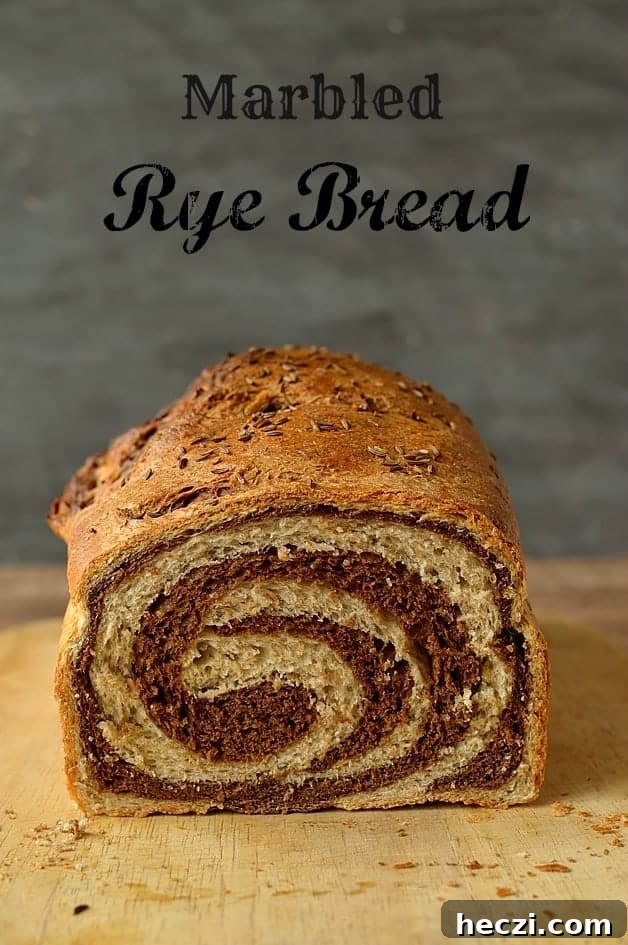
I had accumulated five bags of rye flour, so I knew rye recipes would be appearing here for a while. Marbled rye bread was my first project after spotting a beautiful half-light, half-dark loaf on Pinterest. The finished loaf is visually striking and delicious.
Both the light and dark doughs use the same basic recipe. I coloured the darker dough with a little cocoa powder and treacle so the tones match during proofing — the cocoa adds colour but not a chocolate taste. Using the same base for both doughs helps them rise at the same rate and avoids one half being under- or over-proofed. The loaf combines rye flour with strong white bread flour, giving a soft, light crumb with the wholesome character of rye. It’s perfect for attractive sandwiches, especially with cheese, and makes excellent toast. I finished mine with a sprinkle of caraway seeds for extra flavor; you can also add caraway to the dough if you prefer.
The spiral pattern looks intricate, but shaping is straightforward. I followed a short shaping demonstration and found it quick to make the swirl. This method creates a lovely pattern and is one I’ll use again while working through my rye stash.
If this loaf inspires you to bake more bread, try other varieties such as a rosemary spelt bloomer or a classic brioche with reduced butter. For a creative twist, there are also interesting recipes that use unconventional ingredients, like soy sauce, to add depth of flavor.

Marbled Rye Bread
Ingredients
Light Dough
- 225 g (1 + ¾ cups + 2tbsp) strong white bread flour
- 115 g (scant 1 cup) rye flour
- 5 g (1 ½ tsp) fast action yeast
- 1 tsp salt
- 25 g (scant 2 tbsp) softened butter
- 1 tbsp honey
- approx 220ml (scant cup) water
Dark Dough
- 225 g (1 + ¾ cups + 2tbsp) strong white bread flour
- 115 g (scant 1 cup) rye flour
- 5 g (1 ½tsp) fast action yeast
- 1 tsp salt
- 25 g (scant 2 tbsp) softened butter
- 1 tbsp treacle
- 2 tbsp cocoa powder
- approx 220ml (scant cup) water
- milk and caraway seeds to finish optional
Instructions
-
Place all ingredients for the light dough except the water into a bowl, and do the same for the dark dough in a separate bowl. Gradually add the water to each bowl, mixing until you have a soft, slightly sticky dough; you may not need all the water or you may need a little more.
-
Turn each dough onto an unfloured surface and knead for about 10 minutes until smooth and elastic. Shape each into a ball, place in a lightly oiled bowl, cover, and leave to rise until doubled, about 1½ hours.
-
Grease an approx. 28x13cm (11x5in) loaf tin, or prepare a baking sheet. Punch down each dough and knead briefly, then divide each into two equal pieces. Roll each piece on a lightly oiled surface into a square about 20cm (8in) wide. Stack the squares light, dark, light, dark. Gently roll the stacked squares out to about 27cm (10.5in) square and then roll tightly into a log.
-
Place the log seam-side down in the loaf tin or on the baking sheet. Cover loosely with oiled clingfilm and leave to rise until doubled, 1–2 hours. Preheat the oven to 180°C/350°F/gas mark 4 while it rises.
-
Just before baking, make several deep slashes across the top, brush with a little milk and scatter caraway seeds if using. Bake for 45–55 minutes until well risen and hollow-sounding when tapped on the bottom; internal temperature should reach about 94°C/200°F.
-
Turn the loaf out onto a wire rack and allow to cool completely before slicing.
I am sharing this with several foodie link-ups and events.